





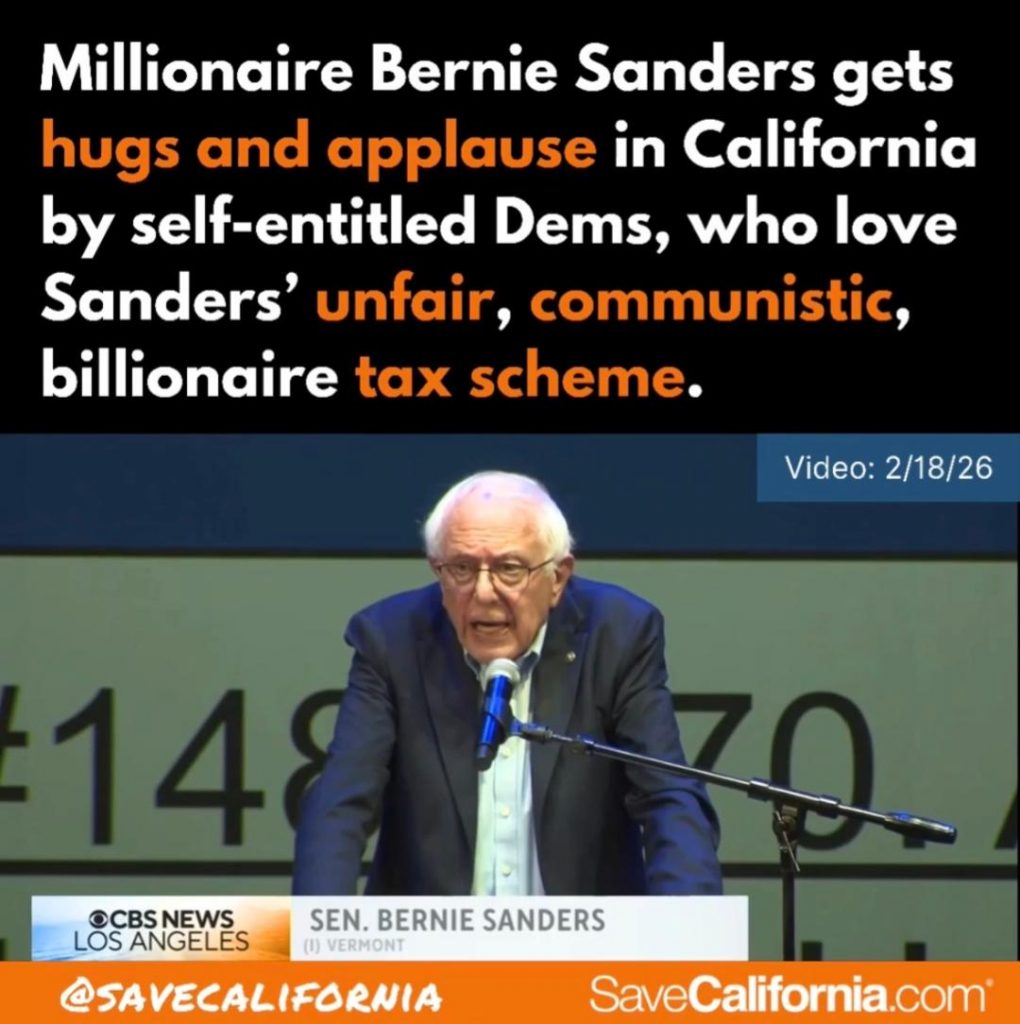
| Be afraid, be very afraid. Gathering signatures right now for the California ballot is an initiative that would levy a one-time 5% tax on the accumulated wealth of billionaires. This is on top of California’s highest-in-the-nation income tax of 14.4%, which applies to wage income over $1 million. Grasp these 3 reasons why the billionaire surtax deserves your opposition: 1. Makes a bad situation even worse: Higher taxes on “the rich” means accelerating the exodus of “the rich” out of California, creating an even bigger hole in the state budget, bigger than that created by Newsom & the Democrats’ free health care for illegals. 2. Threatens the middle class: If this destructive proposition is approved on the November 2026 ballot, California’s rich-dependent state budget means the ruling Democrats will have to slash government “services” or raise taxes on the middle class. 3. Categorically unfair: Rather than a “progressive” tax (which means the more you earn, the more you’re punished), a flat tax is the only FAIR tax, where everybody pays the SAME RATE (and yes, this means “the rich” will still pay a great amount of tax). |
| From A Biblical case for Proportional (flat) taxation by Jeff Hammond In a proportional (or flat) tax system, every dollar of income earned that is taxable* is taxed at the same rate. Thus every individual is treated identically by the tax code. There is strong Biblical support for treating people impartially, and in an opposite way, strong condemnation for showing partiality or favoritism. This is because we are supposed to image God, and God is impartial. Romans 2:11 states clearly that God shows no partiality with respect to salvation, (see also Deut. 10:17, Acts 10:34, Job 34:19, and Eph. 6:9). I agree that this is not conclusive, since it isn’t directly talking about taxation, but it does give us an idea of where God’s heart is for how we treat one another. There is a reason why Lady Justice is blindfolded. However, there are other passages which take us closer to the heart of the matter. Lev 19:15 says “‘You shall do no injustice in judgment; you shall not be partial to the poor nor defer to the great, but you are to judge your neighbor fairly.” In this verse, we are told that not only should we not favor the rich, but surprisingly, we should also not favor the poor (see also Ex. 23:3). But why should we think this has applicability to taxation? A main purpose of Leviticus is to show how the Israelites can live a holy life. Chapter 19 is the pinnacle of how we live holy lives in relation to others, and the commands are given a solid reason—“I am the LORD”–which is repeated throughout the section. Interestingly, Ch 19 is widely viewed as repeating the Decalogue; clearly Leviticus is summarizing the essence of what Holy Living looks like under God’s moral law. In the middle of this section on Holy Living, comes verse 15, which describes what justice looks like. Do we treat each other according to their just due? Lev 19:15 helps us understand that a standard for personal holiness will be reflected in a standard for corporate holiness. As John Hartley says in the Word Biblical Commentary, “Since God is just, his people must establish justice in their courts as the foundation of their covenant relationship with him. The inner strength of a nation resides in the integrity of its judicial system.” While, this is not dealing with taxation, it is dealing with justice in the social setting of the courts—it seems reasonable to conclude that if impartiality is required for the courts, it would be required of government action in general. At least the burden of proof should be on those advocating for a system of partiality, given the extensive Biblical support of impartiality. |
Taxes are necessary. But the system of discriminatory taxation universally accepted under the misleading name of progressive taxation of income and inheritance is not a mode of taxation. It is rather a mode of disguised expropriation of the successful capitalists and entrepreneurs.
Ludwig von Mises, Austrian-American anti-communism, free-market economist (1881–1973)
 RSS 2.0 Feed